
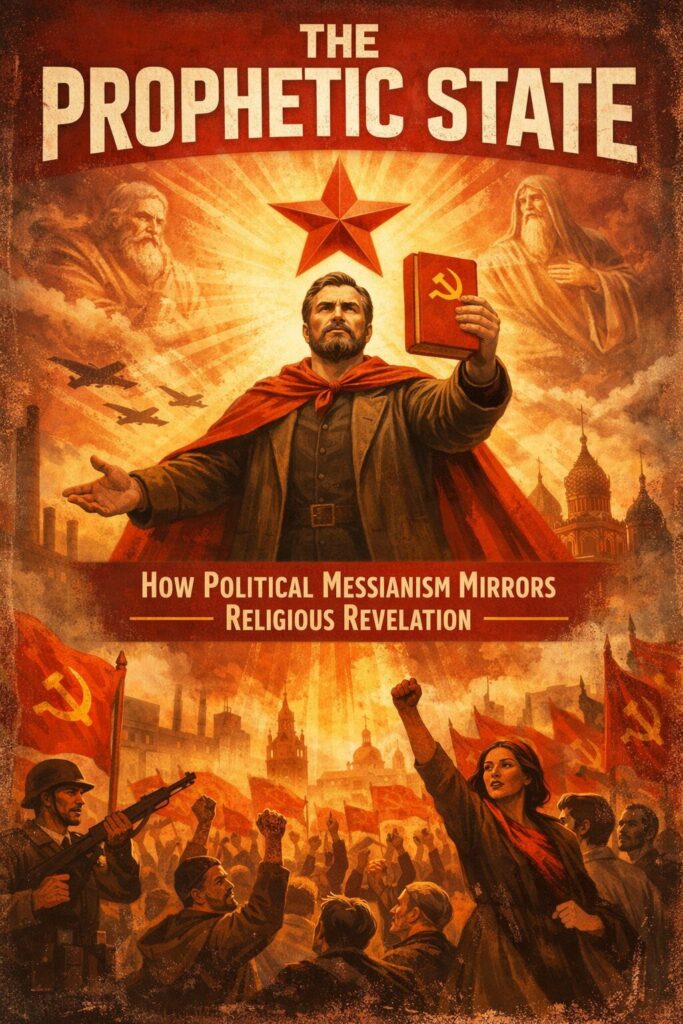
The Prophetic State: Communism & Deep State
How Political Messianism Mirrors Religious Revelation
We all know the feeling—standing in a crowded room, surrounded by noise and confusion, desperately wanting someone to tell you what’s really going on. That’s not just anxiety; that’s humanity at its most fundamental. We don’t just want facts or explanations when times get uncertain. We crave stories that take the chaos and make it matter.
There’s something essential about religion that goes beyond doctrine—it addresses a deep human need for meaning, community, and transcendence. When people leave organized religion, they rarely abandon the psychological architecture that drew them to it in the first place. Instead, that need doesn’t disappear; it gets displaced into new forms that replicate religious structures without the theological framework. This is why movements like communism function so much like religions: they offer salvation narratives (the classless society), sacred texts (The Communist Manifesto), rituals (political gatherings, commemorations), prophets and martyrs, and an apocalyptic vision of history moving toward redemption. The difference isn’t in the structure—it’s that these secular faiths redirect spiritual hunger into a different outlet. People don’t stop seeking what religion once gave them; they just find new temples to fill the void.
Think about prophecy for a second. What comes to mind? Moses parting seas? Nostradamus predicting disasters? Religious leaders claiming special knowledge? Those are the obvious answers, but they miss something bigger. Prophecy isn’t just a religious thing—it’s how humans have organized their politics for thousands of years. It’s the invisible architecture behind revolutions, movements, and even the way we vote.
Here’s what’s fascinating: look at Communism. On paper, it’s an economic theory. But in practice? It operates like prophecy. Followers don’t just agree with policies—they believe in a future revelation, a promised dawn where everything will be different. That’s not accidental. The most powerful political movements throughout history haven’t worked by offering practical solutions alone. They’ve worked by giving people a story they can live into.
Whether religious or secular, these systems rely on prophetic authority—the claim to know a higher truth about the future that justifies present actions. The “Deep State” in this context can be seen as the bureaucratic apparatus tasked with ensuring history follows its prophesied script, regardless of the cost to individuals or the empirical reality of whether that utopia is ever achievable.
The persistence of prophecy in politics reveals something profound: humans don’t just want to understand the world; we want to believe it has meaning beyond our own limited perception. In an age of increasing complexity and uncertainty, this need for prophetic narrative may only grow stronger.
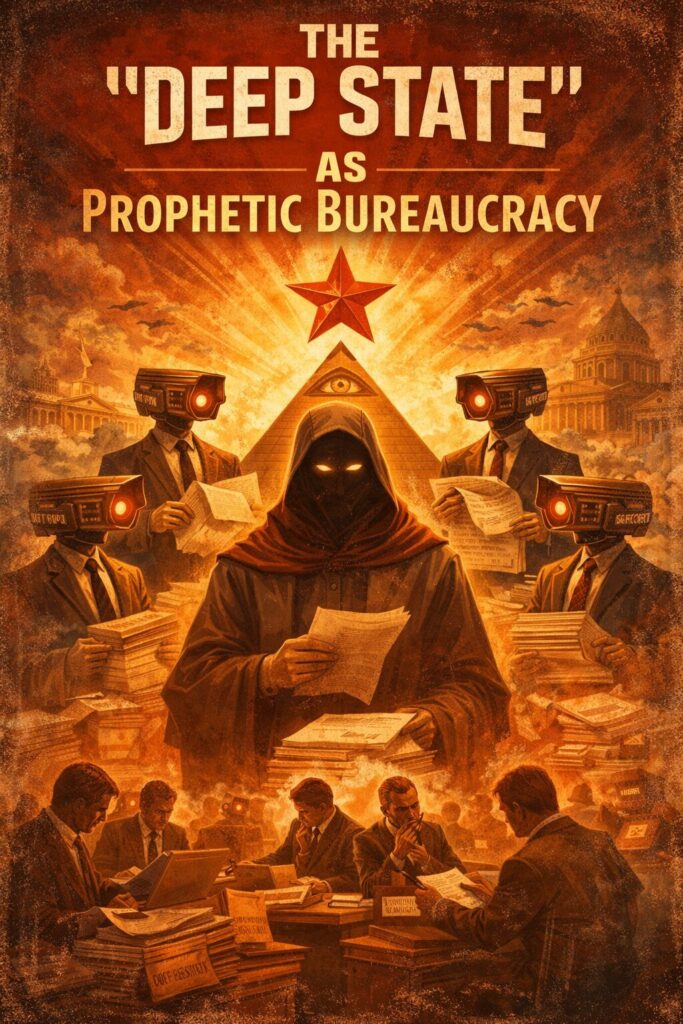
The “Deep State” as Prophetic Bureaucracy
The concept of a “deep state”—a permanent bureaucracy or network of elites operating behind the scenes—can be analyzed through a prophetic lens with striking clarity:
Guardians of the Plan: If history is moving toward a specific goal, then those who understand the plan (the “Deep State”) must guide it. They see themselves not as politicians seeking power for its own sake, but as stewards of an inevitable historical process.
Secrecy as Sacred Knowledge: Prophets often speak in riddles or operate behind veils to protect their message from the uninitiated masses. Similarly, the “deep state” operates through secrecy, believing that true understanding of history is too dangerous for public consumption until the final stage is reached.
Continuity Beyond Leaders: In prophetic traditions, the movement survives even when specific prophets die (e.g., Christianity after Jesus). The “Deep State” functions similarly—it views itself as the eternal engine of historical progress, surviving regime changes because it is the plan in motion.
Why This Structure Persists
The entanglement of prophecy and politics suggests a fundamental human need: We require a narrative that makes sense of chaos.
- Cognitive Ease: It is easier to believe in a grand, prophetic plan than to accept the random, often cruel nature of reality.
- Legitimacy: Political power derived from empirical results (economics) can be fleeting. Power derived from “historical necessity” or “divine will” (even secular will) is absolute and unchallengeable.
- Motivation: If a society believes it is living in the “last days” of history, working toward a prophesied future becomes a moral imperative rather than just a policy preference.
Communism as Secular Religion
Communism, particularly in its 20th-century implementations, functioned with many hallmarks of prophetic religion. Marx’s concept of “historical materialism” posits that history moves according to fixed laws toward a specific endpoint—Communism itself. This is structurally identical to religious eschatology: the belief that time has purpose and an end.
The communist utopia represents the cessation of conflict, scarcity, and alienation—a state of perfection comparable to Heaven or Nirvana. Yet this perfection was always deferred, always “on the horizon.” The revolutionary vanguard claimed access to historical truth that ordinary people lacked, positioning themselves as the chosen interpreters of a divine (or at least inevitable) plan.
This created a paradox: if history is moving inevitably toward communism, then individual agency becomes secondary to the larger process. The prophet-leader doesn’t merely predict; they channel history itself.
The Architecture of Political Messianism
Political messianism mirrors religious prophecy by creating a narrative where current suffering is not random but part of a grand plan leading to a perfected future. This architecture consists of several interlocking components:
| Religious Element | Political Equivalent | Function |
|---|---|---|
| The Prophets | Revolutionaries, Theologians, “Enlightened” Leaders | Claim access to the “truth” of history that others miss. |
| The Sin/Chaos | Capitalism, Imperialism, “The Old World” | Explains current suffering as a necessary condition before redemption. |
| The Messiah | The Revolution, The Dictator, The Vanguard Party | The agent who will bring about the end of history (the utopia). |
| The Apocalypse | The Revolution / Total Transformation | A violent or radical break from the old order to create a new reality. |
This structure provides cognitive closure in an age of uncertainty. When empirical evidence fails to explain why societies suffer, prophecy offers a framework: suffering is not meaningless; it is necessary.
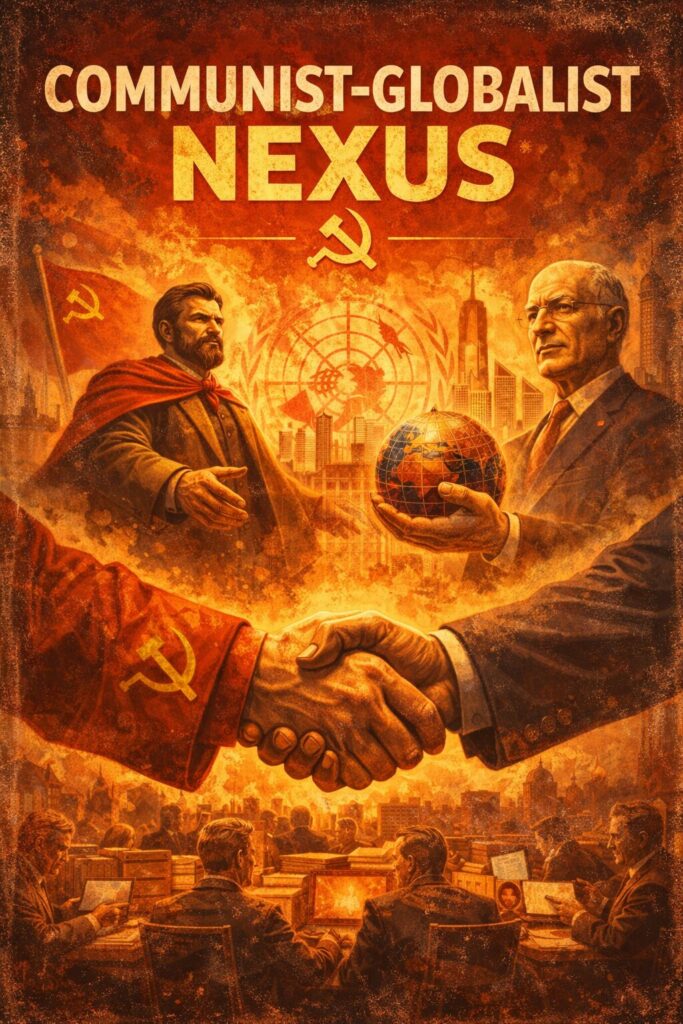
The Philosophical Bridge: Žižek’s Insight -Globalism and Communism
The Slovenian philosopher Slavoj Žižek has explicitly drawn this parallel, stating: “Globalization is not just an economic process; it’s the political realization of communism.”
This claim suggests that globalism may be the secular, institutionalized form of communist universalism—achieving through market mechanisms and diplomatic frameworks what revolution sought to achieve through force. Both seek to dissolve particular identities (national, cultural) into a universal whole.
The parallel is striking: both see current borders and nation-states as temporary obstacles on the path to something greater—a unified humanity operating under a single framework of law and governance.
How They Operate: Similar Tools, Different Names
| Technique | Communist Application | Globalist Application |
|---|---|---|
| Economic Planning | Central Five-Year Plans | International Monetary Fund conditionality |
| Ideological Education | Party schools, propaganda | UNESCO cultural programs |
| Covert Coordination | Underground networks | Diplomatic backchannels |
Both systems rely on:
- Centralized coordination: Decisions made at the top, implemented locally
- Standardization: Creating uniform rules across diverse populations
- Long-term planning: Sacrificing immediate needs for future goals
- Elite governance: Trusting a small group of “understanders” to guide the masses
The core philosophical flaw in both ideologies is the belief that universalism can replace particularity. Humans are not blank slates; we are defined by our cultures, histories, races, and local traditions. These differences are not “obstacles” to be removed but the very fabric of human experience.
- Cultural Erasure: Both systems view distinct cultural identities as inefficiencies or relics of a “backward” past. The Communist goal of a “classless society” often manifested as the suppression of national and ethnic identity in favor of a monolithic collective. Similarly, Globalism promotes a homogenized culture—often Western consumerist culture—that flattens unique traditions into marketable commodities.
- The “One-Size-Fits-All” Fallacy: By imposing universal laws (whether economic or political) on diverse populations, these systems ignore the reality that different communities have different needs and histories. This leads to policies that work in theory but fail catastrophically in practice because they lack local context.
The Mechanisms of Oppression
To achieve this unity, both ideologies have historically relied on mechanisms of control that infringe upon individual liberty and community autonomy.
| Mechanism | Communist Application | Globalist Application | Consequence |
|---|---|---|---|
| Centralized Control | The Party-State; the vanguard decides for the “people.” | Technocratic Bureaucracy; unelected bodies decide for “humanity.” | Individual agency is subsumed by the collective will. |
| Suppression of Dissent | Political purges, secret police, censorship of “counter-revolutionary” thought. | De-platforming, surveillance capitalism, legal frameworks that criminalize dissent (e.g., hate speech laws used against minority cultures). | Truth becomes subordinate to political or economic stability. |
| Economic Coercion | State ownership; forced collectivization of land and labor. | Conditional aid and sanctions; forcing nations to adopt specific economic models under threat of isolation. | Communities are stripped of the ability to self-govern their economies. |
The Destruction of Community: Paradoxically, in seeking to unite humanity, these systems often destroy the local communities that provide genuine meaning and support. When a community is forced into a larger, impersonal structure, it loses its ability to care for itself and its happiness, making it dependent on the very authority that oppresses it.
Historically, both ideologies have carried a paternalistic undertone—the belief that they are guiding “lesser” peoples toward enlightenment. This mirrors the colonial impulse to reshape societies in the image of the ruler, denying those societies the right to define their own future.
Oppression: The Fundamental Paradox
The claim that centralized order brings liberation is philosophically bankrupt. Order requires hierarchy, and hierarchy inherently limits individual autonomy.
| “Benefit” Claim | Realist Counter |
|---|---|
| Stability through centralization | Stability achieved by suppressing natural social friction—creating pressure cooker conditions |
| Rational governance | Technocratic rule ignores that rationality varies across cultures and contexts |
| Predictability | Human behavior cannot be fully predicted or controlled; attempts to do so create unintended consequences |
The realist insight: True order emerges organically from voluntary cooperation, not imposed structures. When authority imposes “order,” it replaces natural social dynamics with artificial constraints that eventually demand ever-greater enforcement.
The organic truth: Nations, Races, cultures, and ethnic groups strongly tend retain their identity regardless of political attempts to dissolve them.
| Forced Unification | Natural Outcome |
|---|---|
| Economic homogenization | Cultural resistance and adaptation |
| Political centralization | Underground movements and counter-cultures |
| Social engineering | Rebound effects that amplify division |
Historical evidence: Every attempt to create a “unified humanity” has resulted in increased fragmentation—whether through Soviet nationalities declaring independence, or global institutions failing to address local grievances. The more centralized the system, the more violently it fractures when pressure exceeds tolerance.
The promise that any ideology can eliminate conflict is not merely naive—it is dangerous. Conflict is inherent to human existence, arising from competing interests, values, and desires.
| Ideological Claim | Realist Reality |
|---|---|
| Communism ends class struggle | Class struggle transforms into ethnic, religious, or ideological conflict |
| Globalism eliminates war through economic interdependence | Economic ties often mask deeper grievances that eventually erupt |
| Technocracy resolves disagreement through “rational” decision-making | Rationality is culturally relative; what appears rational to one group may appear tyrannical to another |
The paradox: Systems claiming to end conflict must first suppress all forms of dissent—including legitimate criticism. This creates the conditions for more explosive, less contained conflicts later.
SYNTHESIS: Realism as the Antidote to Ideology
The Communist-Globalist nexus fails not merely because of its methods or outcomes—but because it operates on false premises about human nature. It assumes that humans can be remade into something other than what they are, and that social complexity can be simplified through centralized control.
Realism demands:
- Acceptance of human diversity as permanent, not a problem to be solved
- Recognition that order without liberty is merely another form of tyranny
- Understanding that conflict cannot be eliminated—only channeled through legitimate, voluntary mechanisms
- Skepticism toward any system claiming to have perfected social organization
The tragedy of ideological systems is that they promise liberation while delivering control. They offer unity while producing fragmentation. And in their pursuit of a perfect society, they destroy the imperfect but functional communities that actually sustain human life.