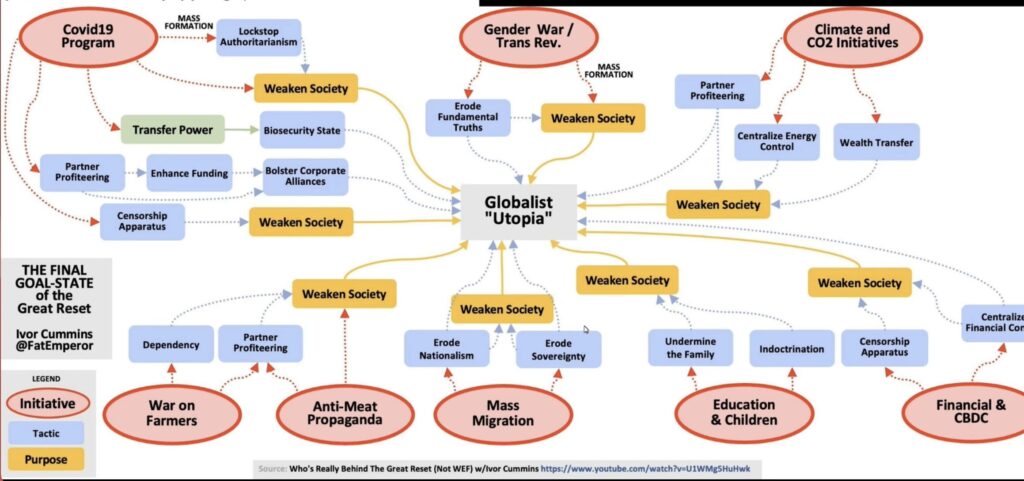
What Do Royalty, Marxism, Globalism and Islamism Have in Common?
The Four Paths to Universal Authority –
At first glance, the comparison seems absurd. On one side, you have the hereditary monarchies of Western Europe—symbols of tradition and bloodlines. On another, you have the faceless bureaucrats of globalism—champions of borderless economics. Then there are the Marxist revolutionaries, seeking the abolition of class and capital, and the clerics of Political Islam in Iran, demanding submission to divine law.
1. The Universalist Ambition
These however, on closer inspection, beneath the surface of apparent contradictions lies a deeper, more unsettling reality, lets start with the first one , the rejection of the nation-state as the ultimate unit of political identity.
The Shared Enemy: The Nation-State
- Western royalty, like the Habsburgs and the Bourbons before them, had always the ambition to create dynastic unities—not simply to rule France or Austria, but to create a European order bound by dynamic marriage and Catholic or Protestant hegemony. While modern constitutional monarchies no longer wield direct political power, the historical archetype of royalty sought a Pax Imperii—a similar, hierarchical order stretching across borders.
- Globalism in the modern secular incarnation envisions a world governed by supranational entities (the UN, the EU, the World Economic Forum) where national sovereignty is eroded. In turn these elite instruments are largely controled by big corporate/financial interests and other elites. The ambition is a single market and a shared set of norms, enforced by sanctions, currency pressures, and climate accords in sort the instruments of the multi ethnic supranational elites.
- Marxism theorized this explicitly. The Communist Manifesto famously declared that “working men have no country.” The ambition was not simply to rule individual countries but to create a worldwide order .
- Political Islam (Velayat-e Faqih), as exemplified for example recently in Iran, operates on the same universalist premise. It rejects the Western concept of the nation-state as a colonial imposition. The doctrine of Wilayat al-Faqih (Guardianship of the Jurist) is not merely a system for governing Iran; it is a transitional stage toward a global Islamic caliphate. The goal is Nazariyat-e Jahani—a global Islamic order that supersedes race, language, and national borders, uniting the ummah under a single religious sovereign.
2. The Vanguard Elite
Each system posits that ordinary people, left to their own devices, are incapable of achieving the utopian vision. Therefore, each relies on a distinct, self-appointed vanguard that claims to interpret the “true” will of the people, history, or God.
The Moral Framing of Oppression
- Royalty claimed divine right. The king was God’s anointed, a living intermediary between heaven and earth. His authority was not derived from the consent of the governed but from bloodline and sacred tradition. To question the king was to question the cosmic order.
- Marxism substituted the monarchy with the vanguard party. Lenin argued that the working class, left to its own devices, would only develop “trade union consciousness,” not revolutionary consciousness. Thus, a disciplined, centralized party (the Politburo) was necessary to guide history toward its materialist end. The “dictatorship of the proletariat” was, in practice, the dictatorship of the party elite.
- Globalism replaces bloodline and class with technocracy. The ambition of the globalist framework is rule by political experts—central bankers, epidemiologists, climate scientists, and NGO directors. Like the vanguard party, this technocratic class argues that the messy democratic processes of nation-states are too slow, too irrational, or too unformed to handle complex global crises. Governance becomes the domain of “stakeholders” rather than elected representatives.
- Political Islam offers the Guardianship of the Jurist. In Iran, ultimate sovereignty belongs not to the people (despite the existence of a parliament) but to the Faqih (Supreme Leader). This cleric is believed to possess superior religious knowledge (ijtihad) and justice (adl), allowing him to override democratic will in the name of safeguarding Islamic interests. Just as the monarch claimed divine right, the Supreme Leader claims to represent the hidden Imam, holding authority until the end of times.
3. The Homogenization of Society
For a universal system to function, diversity—specifically cultural, legal, and moral diversity—must be flattened.
- Historical royalty sought homogeneity through state religion. The principle of cuius regio, eius religio (whose realm, his religion) ended the idea that a king could rule over a plurality of faiths. Dissenters were expelled or persecuted in the name of national unity under the crown.
- Globalism seeks to create the “New Soviet Man.” This involved the destruction of religious institutions, the suppression of ethnic nationalism, and the forced collectivization of agrarian life. The goal was to erase bourgeois identity and replace it with a uniform proletarian consciousness.
- Political Islam enforces homogeneity through Sharia. In the Islamic Republic, cultural diversity (ethnic Kurdish, Baloch, or Azeri identities) is suppressed in favor of a centralized Persian-Shia theological identity. Public life is rigorously homogenized: dress codes, music, education, and even the physical architecture of cities are regulated to reflect a singular interpretation of Islamic virtue. Dissent is not merely political opposition; it is defined as moral corruption (fasad).
- Marxism, sought the creation of ‘Soviet man’ unicitizen of no color no religion a universal mixture like a factory produced doll , to achieve this it involved the destruction of religious institutions , the suppression of Ethnic nationalism and the forced collectivization, to achieve uniform consciousness abolishing individuality.
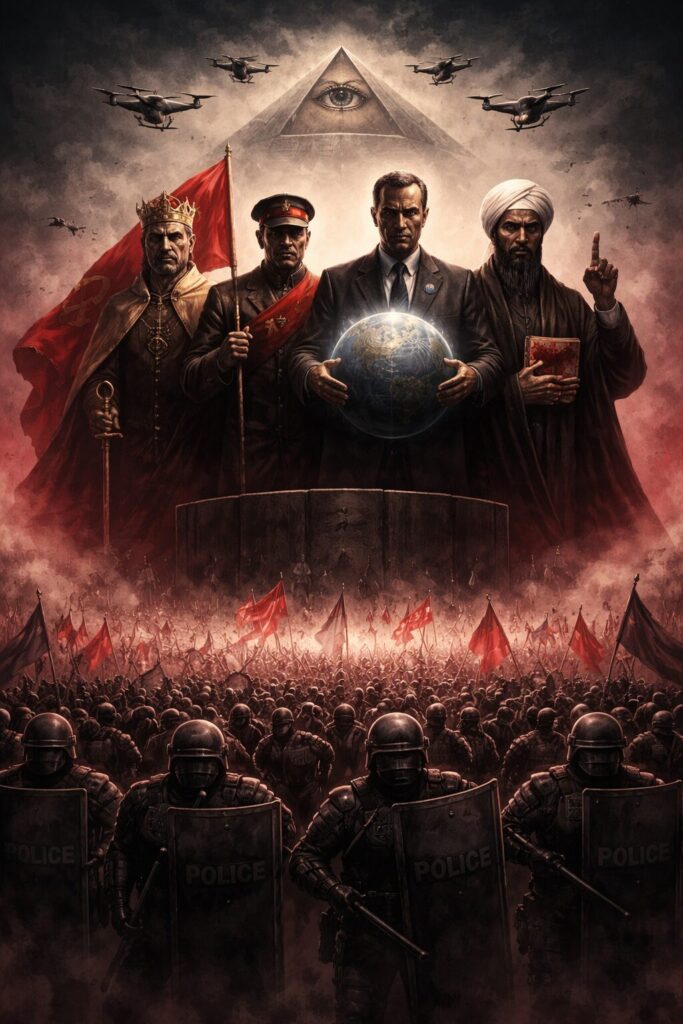
4. The Messianic Endgame
Perhaps the most eerie similarity is the apocalyptic or utopian endpoint. Each ideology promises a final resolution to history’s conflicts—but justifies immense suffering in the present to reach that resolution.
- Western royalty historically framed their wars in eschatological terms. The Crusades, the Wars of Religion, and colonial expansion were justified as the spreading of Christendom. “Endgame” was a world united under the Cross, with the monarch as God’s temporal sword.
- Marxism offered the withering away of the state. The end of history was a communist utopia where exploitation ceased. To get there, however, required “dictatorship,” forced industrialization, and the liquidation of the kulaks (wealthy peasants) as a class. The brutality was justified as the necessary birth pangs of paradise.
- Globalism is increasingly framed in existential terms. The rhetoric surrounding climate change, pandemics, and AI risk has taken on a messianic tone. “The endgame” is the survival of the species, which requires the surrender of national sovereignty to a global governance structure. Like the Marxists who demanded the destruction of the old world to build a new one, globalists argue that the scale of the crises justifies bypassing democratic institutions as the necessary birth pangs of paradise.
- Political Islam possesses a defined apocalyptic eschatology. Twelver Shia Islam, the state religion of Iran, awaits the return of the Mahdi (the Hidden Imam), a messianic figure who will emerge to fill the world with justice. The Islamic Republic’s constitution tasks it with preparing the ground for this return. This justifies the export of the revolution, the pursuit of militant proxies across the Middle East, and the willingness to endure severe economic hardship or even regional war in service of a divine timetable.
The Tyranny of the ‘Ideal’
The similarities between these four seemingly opposed forces reveal a recurring pathology of power. Whether it is a king claiming divine right, a commissar claiming historical inevitability, a technocrat claiming scientific consensus, or a jurist claiming divine law, the structure remains the same.
Each system is defined by a belief in a singular, universal truth that must be imposed on the complex, messy, and diverse reality of human civilization. Each creates a self-justifying elite that claims to act in the name of an abstract entity—the Crown, History, Humanity, or God—rather than the concrete consent of the governed. And each, in its pursuit of a utopian end, justifies authoritarian means.
In the 21st century, the old monarchies of the West have largely become ceremonial. But the ambition they once embodied—the drive for centralized, universal authority—did not die. It simply migrated into new costumes: the bureaucrat, the revolutionary, and the cleric.
The lesson is that whenever a group claims to have found the one universal solution to the human condition, and demands the dissolution of local traditions, national sovereignty, and individual autonomy to achieve it, the result is rarely paradise. It is usually a new form of the old tetrarchy.
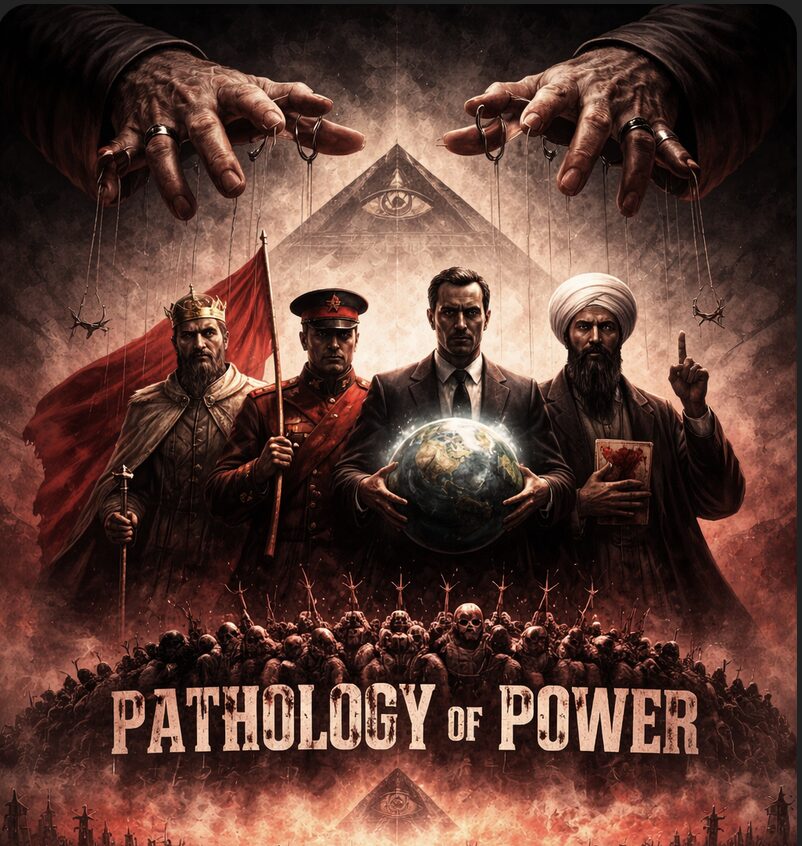
Analysis of this Article’s Core Themes:
- Structural parallelism – Four seemingly opposed systems (monarchy, globalism, Marxism, political Islam) share identical organizational patterns
- Universalist ambition – Each seeks to transcend national boundaries and create a single governing principle
- Vanguard elite rule – All claim special knowledge/authority that ordinary people lack
- Homogenization – Each demands cultural, legal, and moral conformity
- Messianic endpoint – Each promises an apocalyptic resolution requiring present suffering
Open Borders as a Tool of Deconstruction
Perhaps the most significant point of convergence is the policy of open borders. For the Monarch wanting his serfs back and the Marxist globalist, the nation-state is the primary vehicle of capitalism and Western identity. The erosion of borders is seen as a necessary step toward the dissolution of these structures—a way to create a transnational proletariat and dismantle the cultural cohesion that underpins liberal democracy.
For political Islam, open borders in the West serve a different but complementary purpose. The mass migration of populations from the Global South to Europe and North America, facilitated by globalist policy, represents a form of “demographic jihad.” Islamist strategists have long spoken of “conquering” the West without firing a shot, by out-breeding and out-populating native populations to eventually shift the cultural and political center of gravity. The Muslim Brotherhood’s stated goal of “civilizational jihad” aligns with the Marxist goal of a post-national world. The alliance here is functional: the globalist Left provides the ideological justification and policy machinery for open borders, while Islamist groups provide the foot soldiers and cultural leverage to further destabilize existing Western nation-states.
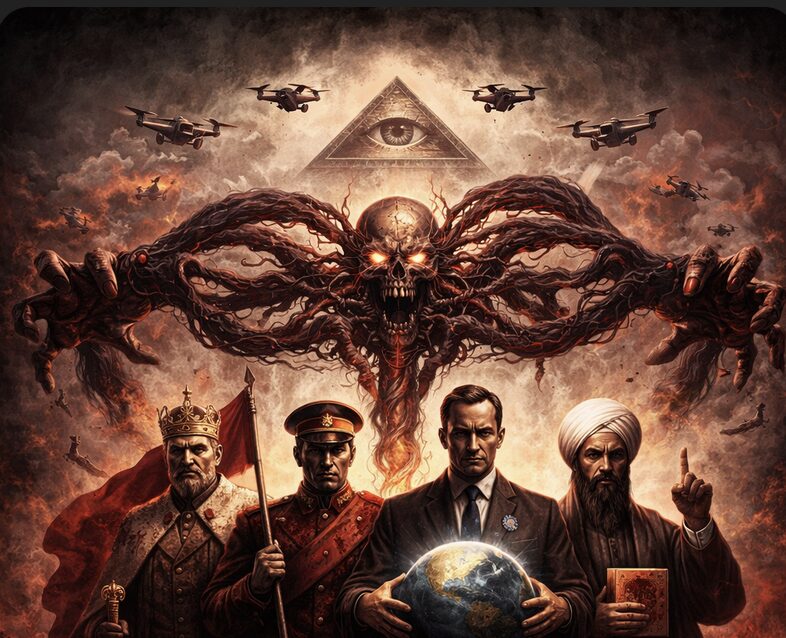
Critiques and clarification:
Constitutional Monarchy (UK Holland Sweden Denmark) – This is an oxymoron, a mere label. There exists either no monarchy or no democracy; these are mutually exclusive political forms. A constitution fundamentally limits the monarch’s authority, directly contradicting the core definition of monarchy as unlimited sovereign power. It functions as a designation for a transitional or decaying political form rather than a genuine continuation of monarchical rule. The monarch—even when effectively emasculated by constitutional constraints—would invariably seek to regain full power. Arguably King Charles III exemplifies this pattern: an ardent globalist and Islamic ‘sympathizer’ pursuing the destruction of the British constitution and society in his bid to fundamentally alter the existing power structure.

For further thought I leave here this Graphic below , relevant to the issues touched upon.