
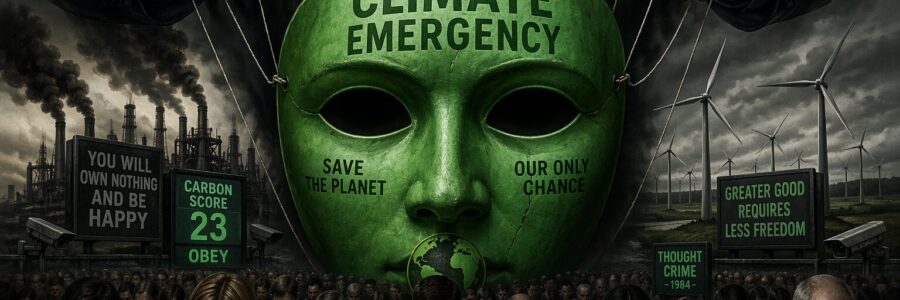
The Green Mask: How Environmentalism Justified Socalist Control
In the history of political ideology, few moments were as significant—or as deceptive—as the convergence of Marxist theory and environmentalism in the mid-20th century. While early socialists often viewed nature as a resource to be exploited or a backdrop for industrial progress, the rise of “Green Socialism” (or Eco-Marxism) fundamentally altered the narrative. It did not merely add an environmental dimension to existing theories; it provided a new, morally potent justification for centralizing power.
This shift effectively “cloaked” the inherent oppressiveness of command economies by framing them not as tools of class domination, but as existential necessities for planetary survival. Here is an exploration of how this ideological shift occurred and why it remains so potent today.
The Shift from Exploitation to Stewardship
Traditional Marxism, particularly as articulated by Marx and Engels, was deeply rooted in the dialectic of capitalism. They argued that the capitalist system exploited labor and nature alike, treating the earth as an infinite warehouse for accumulation. The solution was clear: seize the means of production and redistribute wealth, theoretically leading to an abundance where nature could be respected.
However, as the industrial revolution accelerated and ecological crises began to manifest in the early 20th century, the narrative changed. The Communist Party of China and later the Soviet Union needed a way to explain why they were restricting individual freedoms, centralizing economic planning, and suppressing dissent. They could not simply say, “We are taking your freedom because we want it.” That sounds oppressive.
Instead, they adopted an environmentalist framework. They argued that capitalism was not just economically inefficient but ecologically suicidal. Under this lens, the “oppressive” nature of state control was reframed as a temporary, albeit harsh, measure required to save the biosphere. The individual’s right to private property or economic autonomy was sacrificed for the collective good of the planet. This is what we might call the “Climate Halo.”
The Moral High Ground of Survival
The most effective way to cloak oppression is to make it seem like self-sacrifice. In this narrative, the citizen is not a victim of state overreach but a willing martyr for the environment.
- Centralization as Conservation: Instead of viewing state planning as a violation of individual liberty, it is presented as the only mechanism capable of coordinating complex resource allocation on a global scale. The argument goes: “Only a central authority can manage the delicate balance of our ecosystems.”
- Collective Responsibility: Environmentalism is inherently collectivist. You cannot save the planet alone; you must act as part of a whole. This mirrors the Marxist emphasis on the collective over the individual, but it frames the collectivism as an ecological imperative rather than a political dogma.
- The “Temporary” Nature of Freedom: The narrative often posits that individual freedoms are suspended only until the ecological crisis is resolved. Once the planet is “saved,” full freedom will be restored. This creates a sense of urgency that overrides long-term civil liberties, justifying authoritarian measures as “emergency powers” for the sake of survival.
The Double Standard of Nature
A critical aspect of this ideology is its treatment of nature itself. In many Western liberal democracies, environmentalism often serves as a constraint on industrial growth, sometimes leading to greenwashing or regulatory capture. However, within the framework of Green Command Socialism, nature is not just protected; it is subjugated for its own good.
The logic follows: The planet is sick, and it needs a strong hand (the state) to force behavior change. Individual preferences for consumption or lifestyle choices are deemed “ecological crimes” because they contribute to systemic collapse. Therefore, the state has the moral authority to override individual desires, not because it is evil, but because it is necessary. The oppression is invisible because it is disguised as protection.

The Illusion of Choice
Perhaps the most insidious part of this cloak is how it erodes the concept of genuine choice. In a free market, individuals can choose to buy less or recycle, even if it costs them money. In an eco-socialist framework, these choices are often framed as naive or insufficient. The state dictates consumption patterns, energy usage, and production methods under the guise of “sustainability.”
This creates a paradox: The state claims to be fighting for environmentalism, yet it does so through mechanisms (central planning, censorship, surveillance) that are historically associated with totalitarianism. The “Green Halo” allows these mechanisms to be accepted because they are framed as scientific necessities rather than political tools. The citizen feels compelled to obey not out of fear, but out of guilt or moral obligation to the Earth.
The Reality Check
While this narrative has been powerful for decades, it faces significant scrutiny today. Critics argue that using environmentalism as an excuse for authoritarianism is a form of “greenwashing” on a macro-political scale. It risks creating a system where environmental goals are pursued at the expense of human rights, leading to outcomes similar to those seen in historical command economies.
Furthermore, modern ecological science increasingly suggests that top-down centralization is often less effective than decentralized, community-based solutions. Yet, the “Climate Halo” remains strong because it offers a simple, emotionally resonant story: The Earth is dying, and we must all do our part, no matter how inconvenient .
A Response to ‘climate Change’ Alarmism
- Natural Extremes: History shows that extreme weather events are not anomalies but part of a baseline. The “Little Ice Age” and the Medieval Warm Period demonstrate that global temperatures have fluctuated significantly over centuries. Some alarmist arguments suggest that current warming is unprecedented in 2,000 years; however, when looking at shorter windows (e.g., the last 500 years), the rate of change can be seen as perhaps unique, but the magnitude of past shifts (such as the Holocene Climatic Optimum) suggests that Earth has capacity for significant reorganization.
- Adaptability vs. Fragility: By focusing on catastrophic collapse, alarmism sometimes ignores the Earth’s inherent resilience and adaptability. Historical evidence suggests that ecosystems have recovered from major disturbances (e.g., after massive volcanic winters or ice ages). The critique here is that alarmism often treats the biosphere as a fragile, static system rather than a dynamic one capable of evolution and recovery if given time and appropriate management.
- The “Hockey Stick” Controversy: The debate over whether the 20th-century temperature record was an anomaly or part of a longer trend highlights how data interpretation can be weaponized. Alarmism selectively ignores natural variability to force a narrative of irreversible doom.
The Earth’s climate system has undergone dramatic shifts in the past, often driven by natural events (volcanic activity, solar variability, orbital changes) that greater in magnitude to current anthropogenic events.
Conclusion
The strategy of cloaking command socialism with an environmentalist narrative is one of the most sophisticated forms of ideological manipulation. By linking state control directly to planetary survival, it transforms the oppressive machinery of central planning into a shield for the biosphere. It asks the question: Is it better to have freedom and risk ecological collapse, or to sacrifice individual liberty for the sake of the planet?

In many ways, this is the ultimate test of our values. But as history has shown us, when the “halo” becomes too thick, it is easy to forget who is holding the mask. The result is often a society where environmental rhetoric masks a return to rigid, state-controlled economies, leaving individuals feeling trapped between their personal freedoms and an imposed “necessity.”
Dogmatic Ecological alarmism obscures the complexity of the climate system. By integrating historical data on natural variability and recognising the Earth’s resilience, we can move beyond fear-based narratives toward a more nuanced understanding: one that avoids the trap of political oppression , allowing for honest and scientifically grounded, and economically viable response .
Additionally , when politically motivated scientific models are presented as absolute truth without acknowledging uncertainty, it justifiably erodes public trust in science. This has already occurred to some extend as eco Marxist alarmist rhetoric has been used to justify political agendas, leading to a backlash against pseudo scientific consensus which when it comes to climate change does not exist.